

This article is general information about photo rights as of November 2026, not legal advice. For a specific contract or dispute, talk to an attorney in your country.
In short:
Amy Taylor, the singer of the Australian punk band Amyl and the Sniffers from Melbourne, settled her lawsuit with Los Angeles photographer Jamie Nelson in late October 2026.
Taylor sued because Nelson sold fine art prints from their 2025 shoot for Vogue Portugal. Taylor claimed she had agreed that the photos would run only in the magazine.
What’s next?
The case ended in a private settlement without a court ruling, so it leaves no precedent photographers can rely on. Whether selling fine art prints of a recognizable person person, or anyone, is safe remains an open question. The best protection for photographers and retouchers is a model release that lists every use of the images, signed before the shoot. Download our free model release template, updated for 2027. It covers AI and digital replicas, and includes notes for 17 countries.
Amy Taylor, the singer of the Australian punk band Amyl and the Sniffers from Melbourne, settled her lawsuit with Los Angeles photographer Jamie Nelson in late October 2026.
The fight was over photos from a 2025 shoot for Vogue Portugal. No money changed hands. Nelson keeps the copyright and may keep selling fine art prints from the shoot. Taylor’s side may still object if her image is used to advertise anything else.
The case raises an interesting and important question for photographers: who gets to control the use of a photo of a person, the photographer who owns the copyright, or the person in the photo?
It varies for different regions, we’ll take a look at what is legal and “by the book” in the USA. And here, the answer is twofold:
- The photographer owns the image copyright.
- The person in it retains rights to their name and likeness. In California, where the shoot took place, that is called the right of publicity (a person’s legal right to control commercial use of their identity).

What Happened in the Amy Taylor and Jamie Nelson Case?
The timeline below draws on reporting by Blunt Magazine, which reviewed the court filings and the signed settlement terms, and other sources that covered this legal case.
The suggestions are for photographers and retouchers who intend to go “by the book”.
| What happened | What it means for photographers |
|---|---|
| May to July 2025 | |
| Nelson photographed Taylor at her Los Angeles studio. Nelson says she conceived and paid for the shoot (as reported, it was not a small amount). The images ran in the July 2025 issue of Vogue Portugal. | Settle all planned uses and what happens to the images with the person you are photographing before the shoot day. Read more: Blunt, Amy Taylor’s Photo Lawsuit Is Over |
| September to December 2025 | |
| Nelson offered prints and a zine (a small, self-published magazine printed in a short run) of the series for sale on her website. Taylor’s manager refused print sales. On December 22, 2025, Taylor sued Nelson and her studio in federal court in Los Angeles. | When usage is negotiated after the shoot, each side can claim the other agreed to something different, and that gap is what can cause the dispute to be taken to court. Read more: PetaPixel, Singer Sues Photographer Over Sale of Vogue Images |
| February 2026 | |
| Nelson filed a counterclaim (a claim of her own inside the same lawsuit). She said people linked to Taylor had posted her images on their social media accounts without her permission. | Being in a photo does not give the subject the right to use it, or post it publicly, so your release should say what the subject may do with the images as well. Read more: Blunt, Amy Taylor’s Photo Lawsuit Is Over |
| September 15, 2026 | |
| Judge George H. Wu dismissed Taylor’s endorsement claim (that the prints falsely suggested she endorses Nelson’s business) forever. He treated the photos as artistic work. Her publicity and contract claims, however, went forward, and Nelson had to rewrite her copyright claim. | Selling a portrait as art did not count as faking a celebrity’s endorsement, but owning the copyright did not end the subject’s likeness claims either. Read more: Blunt, Amy Taylor’s Federal Photo Claim Dismissed |
| October 27 to 29, 2026 | |
| The two sides settled at a court-ordered conference. All claims were dismissed, no money was paid, and each side covered its own legal costs. Taylor and the band signed a covenant not to sue (a promise not to bring a lawsuit) over copying, showing, and selling the fine art prints. | Nelson keeps her art sales, and using Taylor’s face to advertise anything else stays off-limits. Read more: Rolling Stone AU, Amy Taylor Settles Legal Battle |
Both sides called the outcome a win.
Nelson said, “Art is worth defending.”
The band said, “All we were fighting for was Amy’s right to say no.”
Read more: Rolling Stone AU, Amy Taylor Settles Legal Battle
5 Lessons From the Case for Photographers & Retouchers
1. Copyright and Likeness Rights Are Separate
Copyright covers the use of a photograph, not the person in it. Nelson owned the copyright, and the court still let Taylor’s claims about the use of her face go forward. The settlement drew the same line. Under the signed covenant, Nelson may sell the prints, but she may not use Taylor’s image to promote other products or her own photography services.
The same split applies when you show client work on your website or social media. The American Society of Media Photographers (ASMP) treats self-promotion as commercial use that needs a release. For example, a retoucher’s before-and-after of a recognizable face on a website needs the photographer’s permission for the image and the subject’s release for the face, which is unlikely for the “before” part.
2. An Editorial Yes Is Not a Commercial Yes
Editorial use means publishing an image to inform or entertain, as in a magazine story, rather than using an image to sell something. Taylor’s complaint said Nelson told her the images would run “exclusively in the July 2025 issue of Vogue Portugal.” Taylor agreed to that. Her side’s position was that she never agreed to prints, a zine, or anything from that shoot to be sold.
A yes to the magazine publication covers the magazine. Every later use reopens the conversation about the image use with the subject.
Retouchers on an editorial job work inside the same limits, so ask what the subject agreed to before the images go into your web portfolio.
The photographer’s side of magazine terms is covered in Why You Should Not Give a Magazine Exclusive Rights to Your Images for Free.
3. A Signed Release Answers What Message Exchanges Cannot
A model release is a signed agreement in which the person photographed allows specific uses of their image. None of the reporting on this case describes a signed release that covered uses after the magazine.
Taylor’s contract claim rested on an implied contract (an implied agreement from conversations and conduct, not from a signed document). The judge let it proceed while admitting he was “somewhat skeptical” of it.
That question took ten months in federal court and never got a final answer. A one-page release with the uses listed would have settled it before the shoot and saved both sides many nerve-racking months, wasted time, and money. Our free model release template lists each use so you can take steps to protect yourself from chaos even before the shoot happens.
4. Fine Art Prints Are Not Automatically Safe
California publicity law covers a person’s likeness on products and merchandise, not only in ads.
In 2001, the California Supreme Court ruled against an artist who sold prints and T-shirts of his drawing of the Three Stooges. The court found that buyers were paying for the actors’ fame more than for the artist’s own creative work.
A fine art print of a famous face can raise the same question. This case settled before a court had to answer it for a reliable precedent. Nelson’s print sales are now protected by an agreement with Taylor, not by a ruling other photographers can count on going forward.
5. The Country Where You Shoot Sets the Rules
The shoot took place in Los Angeles, and Nelson’s studio is in California. The judge rejected the argument that Australia was the better place for the case, so an Australian singer’s dispute stayed in a US court, under US and California law.
Australian law has no right of publicity. A subject there would rely on consumer law against misleading conduct, or on passing off (a claim that someone falsely implied a business connection).
When the subject lives in one country, and you shoot in another, the release should name which country’s law applies. Our free model release template has a line for this and notes for 17 countries.
What Should You Do Before Your Next Shoot?
Add a usage section to your release that lists every use beyond the first publication: prints, zines, portfolio, social media, contest entries, and advertising for your own services.
Have the subject strike any use they refuse, then sign. If a use is struck, you know before you invest in the shoot, not after the prints are listed for sale.
Our free model release template below includes the usage section, with a Yes or No for each use.
Frequently Asked Questions
Did Amy Taylor Lose Her Lawsuit?
Not by a court ruling. The court dismissed one claim, the false endorsement claim. Her remaining claims, two publicity claims and an implied contract claim, ended in the settlement, along with Nelson’s claims against her.
Does This Settlement Set a Legal Precedent?
No. A settlement is a private agreement, not a court decision, so other photographers cannot rely on it. The one ruling in the case came from a single federal trial court and does not bind other courts.
Who Owns the Copyright When a Magazine Publishes a Shoot?
Usually the photographer. The exceptions are a signed contract that transfers the copyright or makes the shoot “a work made for hire”, or a photographer on staff.
The magazine normally receives a license (permission to publish the images on agreed terms). More on ownership in 5 Copyright Facts Every Photographer and Retoucher Should Know in 2026.
Nelson said she produced and paid for this shoot herself, and the settlement left her copyright in place.
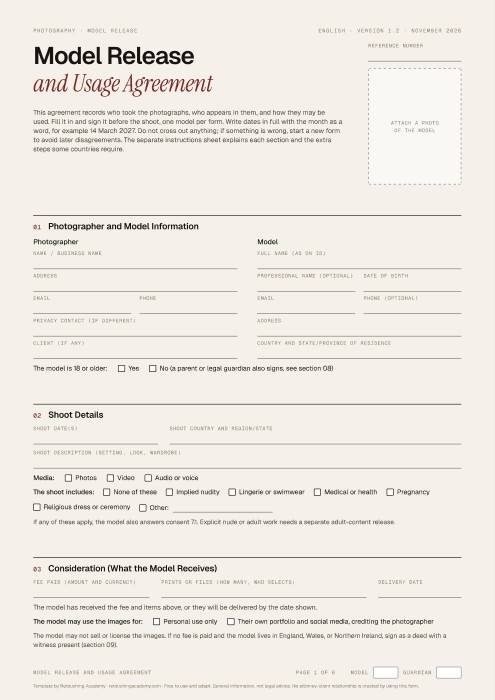
Free PDF download · No email needed
Model Release and Usage Agreement
An 8-page fillable PDF. The model marks Yes or No for each use, including advertising, fine art prints, and AI treatment, so both of you know what you agreed on before the shoot and are protected from any miscommunications that could lead to a lawsuit. An instructions sheet covers the extra steps for photographers in 17 countries.
Version 1.2, November 2026. A general template, not legal advice. Have a lawyer where you work review it before you rely on it.
Future updates. We’ll revise the release when laws on image rights and AI change. Leave your email, and we’ll send you the update.
Sources and Resources
- Blunt Magazine, Amy Taylor’s Photo Lawsuit Is Over. Jamie Nelson Says She Can Keep Selling the Images.
- Blunt Magazine, Amy Taylor’s Federal Photo Claim Dismissed in US Court
- Rolling Stone AU, Amyl and the Sniffers’ Amy Taylor Settles Legal Battle With US Photographer
- PetaPixel, Singer Sues Photographer Over Sale of Vogue Images as ‘Fine Art’ Prints
- Arts Law Centre of Australia, In Vogue, Amyl and the Sniffers: Of Photos, Image Rights and Copyright
- American Society of Media Photographers, Model Release
- Stanford SCOCAL, Comedy III Productions, Inc. v. Gary Saderup, Inc. (2001)
This article is general information about photo rights as of November 2026, not legal advice. For a specific contract or dispute, talk to an attorney in your country.